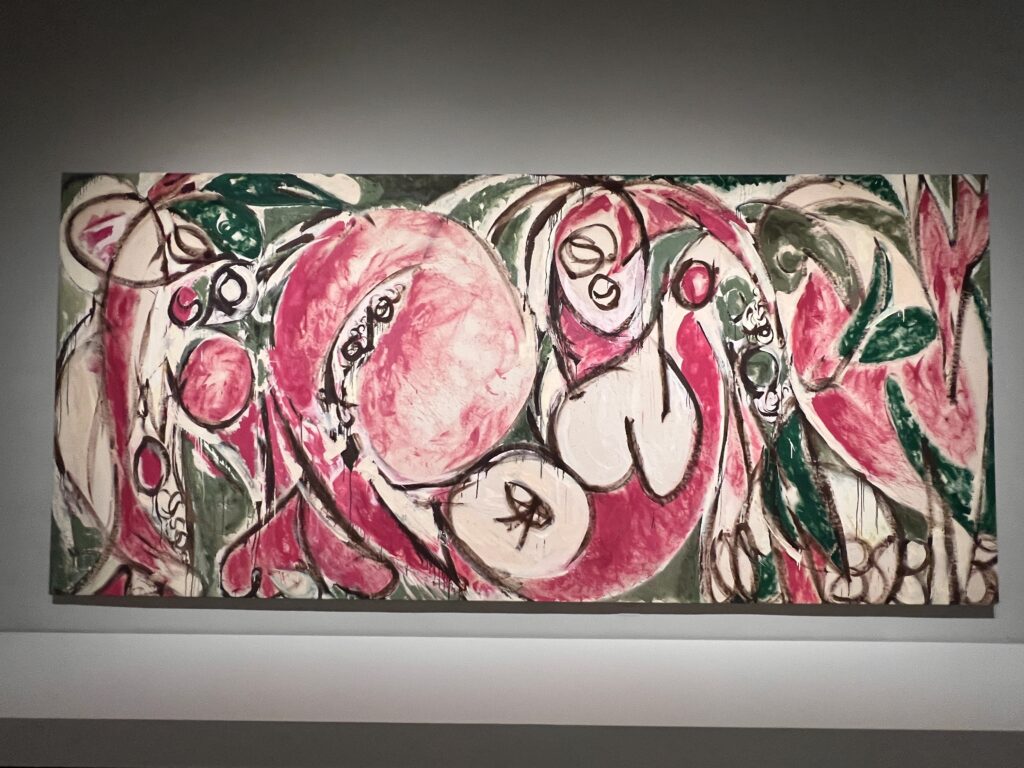
In fall, we shift into a more yin season, where the emotions get a little thicker and heavier. In Traditional Chinese Medicine, fall is associated with grief, which feels almost a little too on the nose for me lately.
Last week, we were in NYC and jazzed that we happened to be in the city one day after the Krasner / Pollock exhibit, Past Continuous, opened. And wow. So many things to say about this exhibit—mainly just immense praise for Lee Krasner, as well as anger over how underrepresented she has been in the art world. I had no idea so many of these paintings even existed.
A huge component of the latter half of this mammoth show was devoted to paintings Krasner made while processing her grief after losing her partner, Jackson Pollock, and then the compounded grief of losing her mother just a few years later.
I was struck by them. Awed, really, by the vulnerability of moving through grief in one of the only ways someone may know how. And I felt how privileged I was to witness it so clearly and concretely in front of me: someone literally working through the pain and heartbreak of loss.
In my own losses, I tend to feel an inability to move. I am frozen in place by the weight of it all, and my body morphs into a sack of bones.
Where so many of us might try to fix grief, eliminate it, outrun it, or shove it down somewhere deep, Lee seemed to let herself feel it. It ran through her like streams of tears and then flowed out through her art into these massive paintings.I was surprised by how light and airy those first paintings were. Delicate. Feminine. Pale pinks and inviting greens. There was grief there, but somehow there was still color. Still spaciousness. Still life. And then, a few years later, after the loss of her mother compounded the pain and absence of Jackson, she began a series called Night Journeys.
The Met describes this period by saying, “Mourning does not operate on a schedule.”
Oof. I completely agree.
The lights, quite literally, went out.
Krasner was experiencing chronic insomnia and began working solely at night. Because she didn’t trust artificial light to accurately render color, her once-vibrant palette shifted toward whites, umbers, and raw, earthy tones.
And still, she painted.
I keep thinking about that.
There’s that old line, “you have to feel it to heal it,” though I’m not sure healing is exactly what I saw on those walls. It felt less linear than that. Grief changes shape, I believe. Grief becomes something else and then morphs into a new shape again.
Not because I believe grief needs to become something beautiful or productive. Not because we need to make something out of our losses in order for them to mean something. Sometimes grief turns me into a sack of bones on the floor, and that is simply where I am. But there was something about standing in front of those enormous paintings and seeing the evidence of grief changing shape over time on those massive canvases.
I don’t really know what to make of it yet.
Maybe that’s why I can’t stop thinking about those paintings.
Grief just seems to be here.
And perhaps, for now, that is the whole observation.
Big breaths and move with love.
Xoxo,
Holly
Share