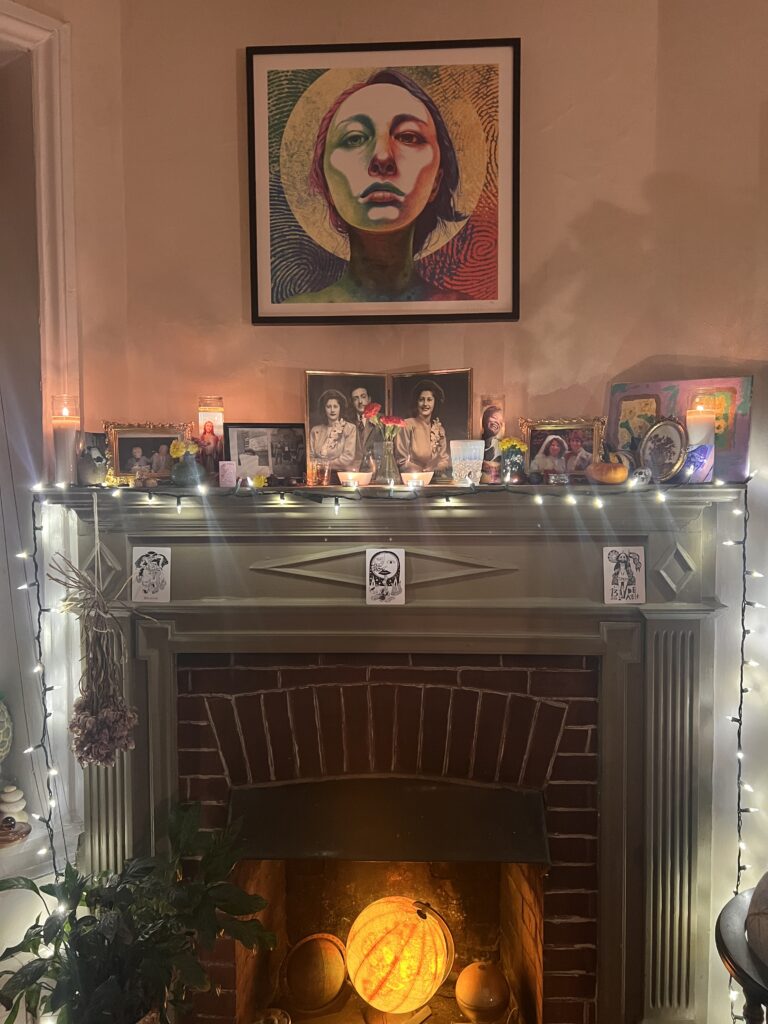
The darkness creeps in a little sooner these days. Some trees have transformed into brilliant shades of red, orange, and yellow, while others stand barren, their branches rattling and screeching in the autumn winds. The air feels thinner, and the cold slithers into our joints, leaving us a little stiffer than before.
We’ve arrived at the halfway point between the autumnal equinox and the winter solstice. A time known in Celtic tradition as Samhain, meaning “summer’s end.”
For the ancient Celts, this was a time when the spirits of the past danced among the living. When the Otherworld existed alongside our own, a world of spirits, ghosts, ancestors, and fairies. A moment when the veil between worlds was believed to be at its thinnest, allowing those who had departed to return, if only for a little while.
Here, we tend to celebrate the ghosts and ghouls of Halloween by dressing up, embracing our fears, and delighting in the darkness. While in Mexico and parts of Latin America, Día de los Muertos is a time to honor deceased loved ones through colorful ofrendas, offerings of food, flowers, photographs, and other cherished objects.
Different traditions, perhaps, but both offer an opportunity to acknowledge what exists beyond the everyday world, including those who are no longer physically here.
It was around this time last year that I had my birth chart read by Suzanne Lang (our chief witch here at MWL). During our reading, she suggested that I spend some time tending to my grief work and encouraged me to create an altar honoring my ancestors and loved ones who had passed.
And so I did.
For over a year now, their photographs have watched over me as I’ve journaled, read books, sipped tea, watched TV, or snuggled beneath blankets. I’ve lit candles, offered them food, and spent countless ordinary moments in their company.
And what a beautiful practice of remembrance it has become.
Recently, I came across an Instagram post by a neuroscientist discussing grief and why we feel such a strong desire to remember those we’ve lost. She explained that, as far as our brains are concerned, the people we love become a part of us. Our relationships shape our memories, our sense of self, and even the way we move through the world.
And when we remember them, whether through a photograph, a familiar song, a favorite meal, or a story we’ve told a hundred times, we can experience a sense of reunion.
I found this idea incredibly comforting.
That remembering someone isn’t simply an acknowledgment of their absence, but also a way of experiencing their presence.
And perhaps that’s why remembrance can feel so bittersweet. We might find ourselves crying while smiling, feeling both the ache of their absence and the joy of having known them.
Because they were a part of us, just as we were a part of them.
And in some ways, they still are.
As we move through these darker days, when the veil between worlds is said to be thin, I’ve been thinking about how beautiful it can be to make space for those we’ve loved and lost. To give our grief somewhere to land, rather than asking it to disappear.
Perhaps that’s what these rituals of remembrance offer us. Not a way out of grief, but a way to be with it. To honor the love that remains long after someone is gone.
So, if you’re feeling called to it, perhaps create a little altar of your own. Light a candle, place a photograph, offer a favorite food, or simply sit for a moment with the memory of someone you miss.
Who knows, maybe the veil isn’t quite as thick as we think.
Move with love and big hugs,
Holly
Share